
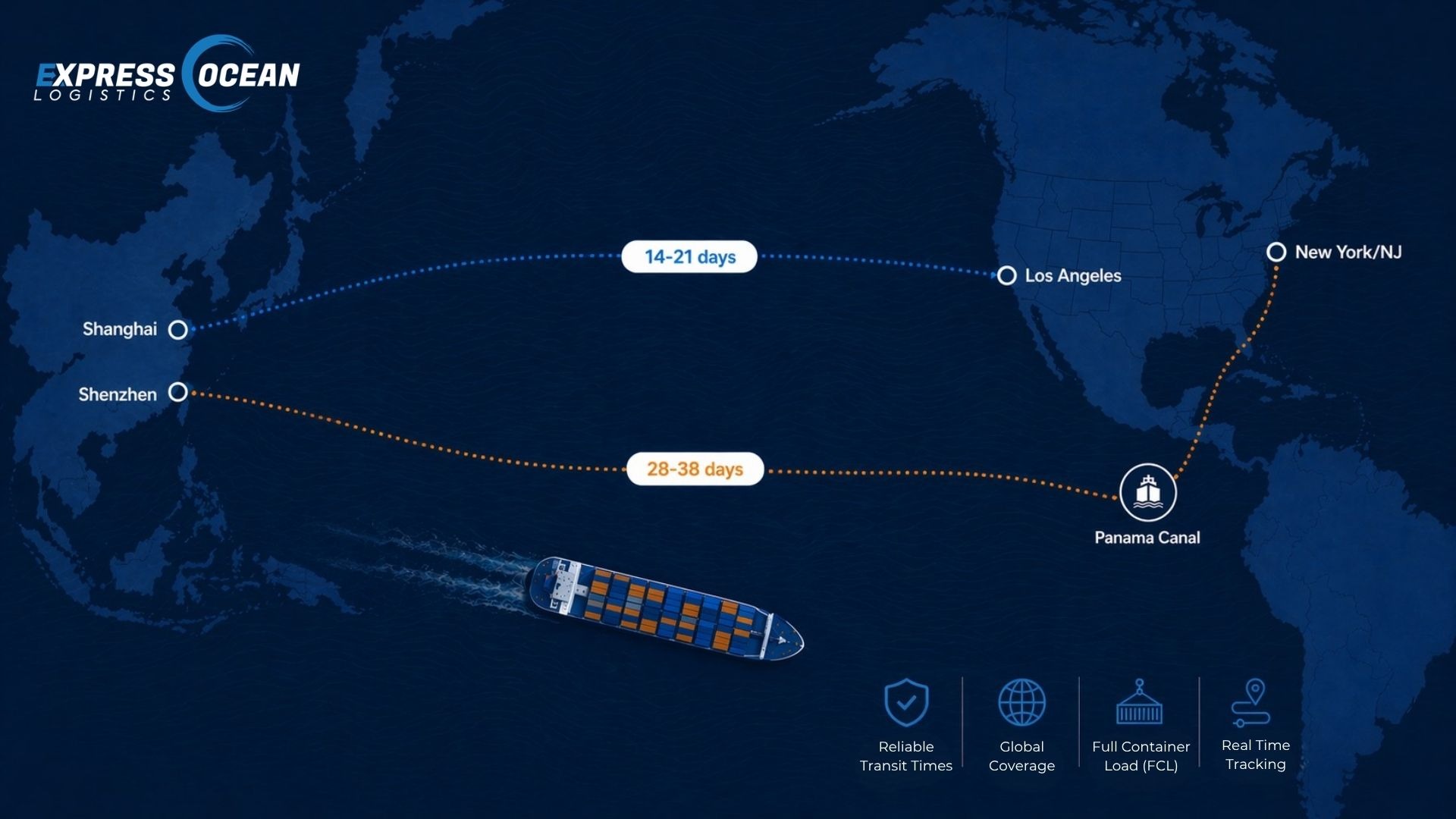
Ocean freight from China to the US takes 14 to 21 days port-to-port for West Coast destinations like Los Angeles and Long Beach, and 28 to 38 days for East Coast ports like New York and New Jersey via the Panama Canal. Door-to-door, including origin pickup, export customs, vessel waiting time, US customs clearance, and final delivery, typically runs 30 to 50 days total. LCL shipments add 3 to 7 days on top of FCL times because of consolidation and deconsolidation at each end.
Transit time is one of the first things importers want to know before they book an ocean shipment from China. The answer depends on where your cargo is going, whether you are shipping FCL or LCL, and a handful of factors that can either compress or extend that window. This guide gives you specific, route-by-route numbers so you can plan your inventory, your production schedule, and your delivery commitments with accuracy.
The team at Express Ocean Logistics has moved cargo on every major transpacific trade lane for over 20 years. The transit times in this guide reflect current real-world sailing schedules and the conditions importers are navigating in 2025.
Transit Time by Route: China to US Ports
The table below covers the most common ocean freight routes from major Chinese origin ports to US destination ports. These are port-to-port times for standard FCL shipments on direct or near-direct services. LCL and door-to-door times are covered in the sections that follow.
| Origin Port (China) | Destination Port (US) | Route | FCL Transit (Days) |
|---|---|---|---|
| Shanghai / Ningbo | Los Angeles / Long Beach | Trans-Pacific (North Pacific) | 14 to 21 |
| Shanghai / Ningbo | Seattle / Oakland | Trans-Pacific (North Pacific) | 14 to 18 |
| Shenzhen / Guangzhou | Los Angeles / Long Beach | Trans-Pacific (South Pacific) | 16 to 22 |
| Qingdao / Tianjin | Los Angeles / Long Beach | Trans-Pacific | 16 to 23 |
| Shanghai / Ningbo | New York / New Jersey | All-water via Panama Canal | 28 to 38 |
| Shanghai / Ningbo | Savannah / Charleston | All-water via Panama Canal | 28 to 35 |
| Shanghai / Ningbo | Houston (Gulf Coast) | All-water via Panama Canal | 30 to 40 |
| Shanghai / Ningbo | New York / New Jersey | Land bridge (land in LA, rail east) | 24 to 30 |
West Coast vs East Coast: Which Route Is Right for You?
Choosing between landing at a West Coast port or an East Coast port is one of the most consequential routing decisions for importers shipping from China. It affects your transit time, your freight rate, your inland delivery cost, and your exposure to port congestion risk. Here is how each option breaks down in practical terms.
If your warehouse or distribution center is on the East Coast, shipping direct to New York, New Jersey, or Savannah is often the right choice even with the longer ocean transit. Landing at Los Angeles and using intermodal rail to reach the East Coast adds 7 to 10 additional days for the rail leg and significant inland transportation cost. For importers near New Jersey, Express Ocean Logistics coordinates direct ocean freight services into the New York/NJ port complex, which is the closest major port to our Cranford headquarters.
How FCL and LCL Shipping Times Differ
The distinction between Full Container Load (FCL) and Less than Container Load (LCL) affects not just your freight rate but the total time your cargo spends in transit.
FCL shipments move from the origin factory or warehouse directly into a dedicated container. Once sealed, that container goes onto the vessel and arrives at the US port where it is released directly to you. The only variables affecting your timeline are the ocean transit itself, port processing speed, and customs clearance.
LCL shipments work differently. Your cargo is taken to a Container Freight Station (CFS) at the origin port, where it is consolidated with other shippers' goods to fill a single container. After the vessel arrives at the US destination port, the container is deconsolidated at a destination CFS before your cargo is released. This consolidation and deconsolidation process adds 3 to 7 days on top of the ocean transit time, and your cargo has more handling points along the way.
| Route | FCL Port-to-Port | LCL Port-to-Port | LCL Extra Time |
|---|---|---|---|
| China to US West Coast | 14 to 21 days | 21 to 30 days | +3 to 7 days |
| China to US East Coast (all-water) | 28 to 38 days | 35 to 45 days | +3 to 7 days |
For most importers shipping volumes under 15 cubic meters, LCL is still the practical choice despite the longer timeline. Once your shipment consistently exceeds that threshold, switching to FCL usually makes sense on both time and cost grounds. If you are not sure which option fits your current volumes, our team can walk you through both when you request a quote.
The Full Door-to-Door Timeline Explained
Most transit time figures you see online refer only to the ocean leg, from origin port to destination port. When you are planning your supply chain, what actually matters is the door-to-door time: how many days pass from the moment your cargo leaves the supplier's facility in China to the moment it arrives at your warehouse in the US.
Here is a realistic breakdown of every stage in a typical FCL door-to-door shipment from China to a US East Coast destination.
Cargo is collected from your supplier's facility and transported to the origin port or CFS for container loading. Time depends on the factory's distance from the port.
Chinese customs processes the export declaration. Your freight forwarder handles this alongside the ISF filing to US CBP, which must be submitted at least 24 hours before the vessel departs.
Containers are held at the origin port until the next scheduled sailing. Most major trade lanes have weekly or twice-weekly sailings. Booking closer to the cutoff date reduces this wait; booking early sometimes means waiting for the next vessel.
The vessel crosses the Pacific. West Coast destinations take 14 to 21 days. East Coast all-water routes take 28 to 38 days. A land bridge from West Coast to East Coast takes 24 to 30 days total including the rail leg.
After the vessel arrives, the container is unloaded and moved to the terminal. US CBP processes your customs entry. A standard entry with accurate documentation typically clears within one to two business days. A hold or exam adds time. Our customs brokerage team files entries in advance to minimize this window. You can read more about how to prevent delays in our guide on avoiding US customs delays.
Once customs releases the container, it is picked up from the terminal and delivered to your facility or warehouse. For destinations within a day's drive of the port, this is typically one to two days. Intermodal rail to inland destinations adds more time.
What Makes Your Shipment Faster or Slower
Transit times on any trade lane are rarely fixed. Several variables push delivery windows earlier or later than the baseline numbers, and understanding them helps you plan more accurately and respond faster when conditions shift.
- Seasonal shipping volumes and carrier blank sailings
The transpacific peak season runs from July through October, when importers rush goods ahead of the US holiday season. During this period, vessel space tightens, rates increase, and port congestion at both US West Coast and East Coast ports can add 5 to 10 days to your delivery window. Chinese New Year (January to February) creates a secondary disruption as factories close and then reopen with a surge of outbound shipments. Booking 4 to 6 weeks in advance is strongly advised during both peak windows.
- Port congestion at origin and destination
Los Angeles and Long Beach together handle nearly 40% of all US container imports. When volume spikes, vessels queue at anchor waiting for berths. In the peak of 2025's pre-tariff rush, dwell times at LA/Long Beach reached 2 to 3 days for containers already on the dock, with additional vessel queue time on top. East Coast ports including New York/NJ and Savannah experience their own congestion, though they typically recover more quickly due to greater terminal automation investment.
- Direct service vs transshipment routing
Direct vessel services go from a Chinese port to a US destination port without stopping at an intermediate transshipment hub. Transshipment services call at a hub like Busan, Singapore, or Kaohsiung and transfer cargo to a second vessel for the final leg. Direct services are faster and more reliable. Transshipment routes can add 5 to 10 days and introduce an additional risk point if the connection vessel is missed or the hub port experiences congestion.
- Documentation accuracy and customs clearance speed
A late ISF filing, an incorrect HTS code, or a vague commercial invoice can result in a CBP hold that adds days or weeks to your timeline right at the point when your cargo is closest to delivery. Documentation errors are entirely preventable. Filing your ISF 48 hours before vessel departure rather than the minimum 24, and working with a licensed customs broker who reviews your entry before submission, keeps the clearance window tight and predictable.
- Weather events and geopolitical route disruptions
Pacific typhoons during summer months can cause vessels to slow or reroute, adding 2 to 4 days. Major disruptions, such as the Red Sea crisis that began in late 2023 and continued through 2025, forced many vessels on Asia-to-Europe routes onto the Cape of Good Hope, adding 10 to 14 days to those lanes. While this did not directly affect the Trans-Pacific route to the US, it tightened global vessel capacity and contributed to rate volatility and occasional schedule disruptions on US-bound trade lanes as well.
- Inland transportation and intermodal delays
For importers whose final destination is inland, such as Chicago, Dallas, or Atlanta, the land leg after the port can be as long as the ocean leg. Intermodal rail from Los Angeles to Chicago takes 7 to 10 days. During peak season, containers can sit at the LA port for 5 to 10 days waiting for a railcar, known as rail dwell time, before they even begin that journey. Choosing an East Coast port for East Coast destinations, or working with your freight forwarder to pre-plan inland routing, removes this variable.
How to Get an Accurate Delivery Window for Your Shipment
The transit time ranges in this guide give you a solid planning baseline. For a specific shipment, the most accurate ETA comes from your freight forwarder once a vessel is booked and a sailing schedule is confirmed.
At Express Ocean Logistics, every shipment is tracked through our digital platform from origin pickup through final delivery. Once your booking is confirmed, you receive a Estimated Time of Departure (ETD) and Estimated Time of Arrival (ETA) at the destination port. As the vessel sails, our team monitors the carrier's schedule for any changes and updates you proactively if the ETA shifts.
For importers who are just beginning to plan their first ocean freight shipment from China, our step-by-step guide on shipping by ocean freight for the first time covers every stage of the process, including what to expect at each milestone and how to prepare your documentation before cargo ships.
Practical Ways to Reduce Your Total Transit Time
You cannot speed up the Pacific Ocean. But several decisions you make before cargo ships can meaningfully compress your total door-to-door timeline.
Book your vessel space 4 to 6 weeks in advance during peak season. During July to October, the carriers that offer the fastest direct services fill up first. Waiting until the cargo is ready to book means you may end up on a transshipment routing or a vessel with a later departure, adding days before the ocean leg even starts.
Choose direct service over transshipment routing whenever possible. When you request a quote, ask your freight forwarder specifically whether the service is direct or involves a transshipment hub. Direct services are not always the lowest rate, but they consistently deliver shorter and more predictable transit times.
Get your documentation ready before the cargo is finished. Your ISF must be filed before the vessel departs. Your commercial invoice and packing list need to match the ISF exactly. Preparing these documents while your supplier finishes production, rather than waiting until cargo is ready to ship, eliminates the most common source of pre-departure delays. Our digital logistics solutions give you a platform to manage documentation alongside your shipment status in real time.
Consider the land bridge option for East Coast destinations. For shipments going to New York, New Jersey, or other Northeast destinations, landing at Los Angeles and using intermodal rail can be 5 to 8 days faster than the all-water route via Panama, depending on the origin port in China and current Panama Canal conditions. It is worth asking your freight forwarder to compare both options on each shipment, because the time and cost equation shifts depending on the season and carrier schedules.
Frequently Asked Questions About Ocean Freight Transit Times from China to the US
These are the questions importers at Express Ocean Logistics ask most often when planning shipments from China.
How long does ocean freight take from China to the US?
How long does FCL shipping from China to the US take compared to LCL?
Which is the fastest ocean freight route from China to the US?
Why is ocean freight from China to the East Coast slower than the West Coast?
What factors can delay ocean freight from China to the US?
How long does door-to-door ocean freight take from China to the US?
Plan Your China Import Timeline with Confidence
Express Ocean Logistics manages ocean freight on every major transpacific trade lane. Tell us your origin, destination, and cargo details and we will confirm your options and transit windows.
Get a Free Freight Quote